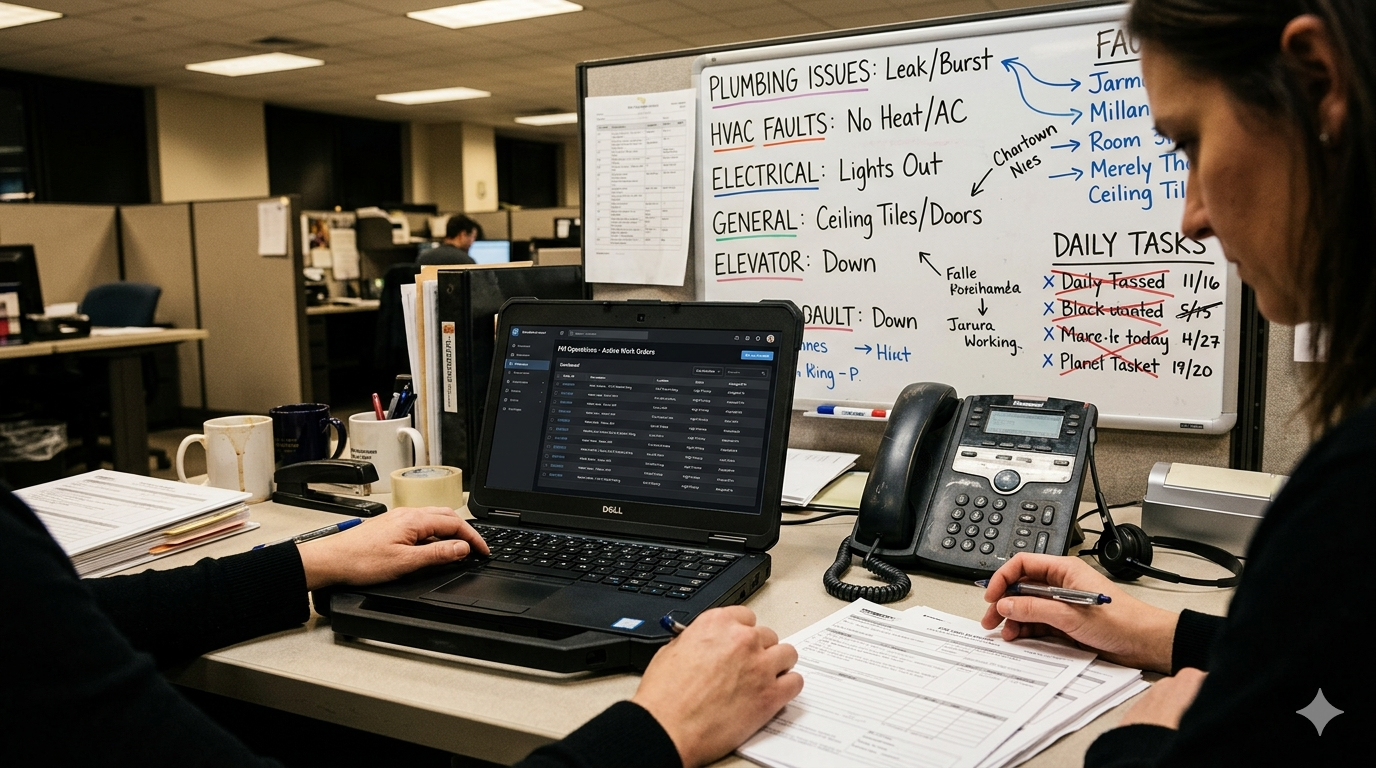
Picture this. A tenant on level 14 sends a WhatsApp message at 9:14 AM reporting that the air-conditioning on their floor is not working. At 9:31 AM, someone from the same company emails the building management address with the same complaint. At 9:45 AM, the floor manager calls the front desk directly. Three contacts. One problem. But in the spreadsheet, it will look like three.
The facilities team logs each one separately, under slightly different category labels, on two different sheets. No SLA clock is running on any of them. By day three, the fault still has not been fixed, the tenant has called again, and someone from their side has started reading through the lease.
This happens regularly in Singapore’s commercial buildings. It is not a people problem. It is what happens when complaint management is built on top of tools that were never intended for the job.
The Real Problem with Email, WhatsApp, and Phone
None of these channels are the issue on their own. Tenants will always use whatever is most convenient, and in Singapore that usually means WhatsApp first, email second, phone if they are frustrated. The problem is that each channel sits in its own silo with no connection to the others and no shared record of what has come in.
When the same fault arrives through three channels, there is nothing to flag the overlap. Staff log what they see. The spreadsheet grows. Complaint volume looks higher than it is, reconciliation takes time no one has, and the underlying pattern — three contacts about one fault — never gets joined up.
Categorisation makes this worse. When it is left to whoever handles each contact, the same fault type ends up labelled differently depending on who logged it. “Aircon” from one person, “ACMV fault” from another, “temperature complaint” from a third. Three months later, when you try to work out whether a particular floor has a recurring cooling problem, the data is too inconsistent to tell you anything useful.
And then there is the SLA question. A spreadsheet has no awareness of time. It cannot tell you that an urgent fault logged at 9:14 AM is approaching its two-hour response window. You find out an SLA has been breached when a tenant mentions it, or when you review the log at the end of the week. Either way, it is already too late.
For buildings managed under the Building (Strata Management) Act 2004 (BSMA), there is an additional layer of risk. Where a subsidiary proprietor can show that the management corporation failed to respond adequately to a notified defect — a water leak affecting their unit, say, traced back to a common property pipe — the Strata Titles Boards have the power to order rectification and award costs. In those proceedings, the quality of the FM team’s records is everything. A spreadsheet note that reads “called back, will follow up” does not hold up well.
Where the Workflow Actually Breaks Down
It is tempting to frame this as a technology gap. In practice, it is a process gap that technology is being asked to paper over.
The response time problem is straightforward: without a system that timestamps each complaint at the point of receipt and tracks it through to resolution, SLA compliance cannot be enforced. Commercial leases in Singapore routinely include response time commitments — typically somewhere between two and four hours for urgent faults, twenty-four to forty-eight hours for routine requests. Meeting those commitments consistently is not possible when the first notification that a deadline is approaching is a tenant’s follow-up call.
Recurring faults are a subtler problem. Take a chiller serving a run of floors that trips every six or seven weeks. In a spreadsheet, each occurrence is a standalone entry, logged under whatever label was used that day, with no link to the previous ones. No one sees the frequency until it has already generated enough complaints to prompt a formal objection in writing. By that point, the maintenance record looks reactive because, structurally, it is.
Visibility within the team is another real gap. When a complaint comes in via WhatsApp to an individual staff member’s personal phone, that is where it stays until someone manually transfers it somewhere else. Handover shifts, leave cover, and staff turnover all create moments where in-flight complaints simply fall through. There is no queue that survives a personnel change.
And when things do escalate — to building ownership, to a managing agent’s head office, or to the Strata Titles Boards — the FM team’s position depends entirely on being able to produce a coherent, timestamped record of what arrived, when, who handled it, and what happened. That record needs to exist before the dispute, not be assembled hastily during it.
What Automation Can and Cannot Do Here
Automation does not solve the process problem. It makes a good process easier to enforce consistently. That distinction matters, because there is a version of this that gets implemented backwards: the technology goes in before anyone has agreed on fault categories, SLA tiers, or escalation paths, and the system promptly produces chaos at greater speed.
Done in the right order, the case for automating complaint intake is straightforward. Tenants do not need to change how they contact you. The goal is to catch each inbound message — email, web form, eventually WhatsApp — at the point of receipt and turn it into a structured ticket before any human has touched it.
Email intake is the easiest starting point. A dedicated building management address, connected to an automation workflow, can parse each incoming message, apply an initial category using keyword rules or AI-assisted classification, create a ticket with a timestamp and a reference number, and fire back an acknowledgement to the tenant within seconds. The SLA clock starts at receipt, not when a staff member gets around to reading it.
Web-based intake forms add another channel that enforces categorisation at source. A QR code posted at lift lobbies or the main reception links tenants to a short form with a fixed category list. No free text, no ambiguity. The submission creates a ticket directly, same as an email.
WhatsApp is where most Singapore tenants will actually be. Connecting a dedicated WhatsApp Business number to the same workflow means messages no longer arrive on a personal phone and disappear into someone’s chat history. The number can send an automatic acknowledgement, the message creates a ticket, and the team gets notified through whatever channel they actually monitor.
One thing worth saying plainly about AI categorisation: it will misclassify. A message about “the smell on level 8” could reasonably land in plumbing, sanitation, or common area — depending on how the system was set up. AI-assisted categorisation is useful for handling volume and reducing manual input, but it needs a human review step for anything ambiguous, and the category list needs to be audited periodically. The benefit is consistency at scale, not accuracy at every edge case.
A Working Starting Point: Free Workflow Template
To make this more concrete, Cadence Innovations has published a free workflow template on n8n, an open-source automation platform, that covers the core triage loop.
What It Does
When a complaint arrives — by email or via an online form tenants can access by scanning a QR code — Claude AI reads the message and handles three things automatically: it assigns a fault category, sets a priority level (critical, urgent, or routine), and writes a personalised acknowledgement email to the tenant. That goes out immediately. The tenant has a ticket number and knows their expected response time before any staff member has seen the message.
The complaint is logged in a tracker, the responsible technician is identified by fault type, and the team gets a one-line alert in their messaging channel. Once an hour, the system checks for any open tickets past their response deadline and sends a separate escalation notice to FM management.
Every complaint logged consistently from arrival. Every tenant acknowledged within seconds. Overdue tickets surfaced before the tenant calls again.
How It Can Be Extended
The template handles intake, classification, acknowledgement, and SLA escalation. From there, common additions include:
- WhatsApp intake — connecting a WhatsApp Business number so tenant messages enter the same triage flow as emails, with no change required on the tenant’s side
- Team messaging integration — routing alerts to whichever platform the team already uses day-to-day
- Recurring fault alerts — a weekly check that flags any asset generating three or more complaints in thirty days, surfacing the pattern before it becomes a written objection
- Closure confirmation — an automated message to the tenant when their ticket is resolved, with an optional one-question rating
The template is free to import at n8n.io/workflows/14292.
The Value Is in the Data That Accumulates
A ticket system is useful from day one. It becomes genuinely valuable at the six-month mark, when there is enough data to spot patterns.
Linking each ticket to a specific asset — a chiller, an AHU, a lift, a particular FCU unit — builds a service history that does not exist in a spreadsheet. When the same asset generates five tickets in ninety days, that is visible. The chief engineer can see what the faults were, how long each one took to resolve, and how much technician time has been spent on it. That is the basis for a decision about whether continued repair is the right call or whether the asset should be scheduled for overhaul or replacement.
Without that linkage, the same asset can fault repeatedly across a year and nobody aggregates the picture. Each incident is handled in isolation. The team looks reactive not because they are slow, but because their system cannot produce the information needed to get ahead of it.
The same logic applies at portfolio level. An FM provider managing several buildings with the same FCU model installed across multiple sites can, if the data is structured consistently, detect a fault pattern across buildings. That kind of analysis does not happen in spreadsheets.
What to Actually Look for in a System
Rather than listing features, it is more useful to describe the questions a well-configured system should be able to answer at any point in time:
Which complaints are currently open, who owns them, and how much time is left on their SLA? How many complaints came in this month, in what categories, and how does that compare to last month? Which assets have generated more than two or three tickets in the past thirty days? What is the average time from complaint receipt to resolution, broken down by fault type? Are there any tenants who have raised the same issue more than once without a confirmed resolution?
If a system cannot answer those questions without someone pulling data manually and cleaning it up in a spreadsheet, it is not doing the job.
A few practical things that matter more than they might appear: the fault category list should be fixed and agreed before go-live, not left as a free text field to be sorted out later. Asset linkage requires an asset register that actually exists and is current — many buildings do not have one, and without it, ticket-to-asset linkage is wishful thinking. And tenant-facing communication — the acknowledgement, the status update, the closure message — is not optional. A system that operates invisibly to the tenant does not reduce follow-up calls. It just delays them.
Common Implementation Pitfalls
Importing old spreadsheet data directly. If historical complaint data has inconsistent categories, bringing it into a new system will corrupt the category structure from the start. Either clean and reclassify it first, or treat it as archived reference only and begin fresh.
Setting SLA tiers before reading the contracts. SLA commitments need to come from the actual tenancy agreements and FM service contracts in place, not from what seems reasonable. A tier that does not match the contract creates a performance target with no operational relevance.
Underestimating change management. The most common failure mode in these rollouts is that staff keep using old channels after go-live because no one told them clearly enough that the process had changed. Written procedures, a briefing session, and a hard cutover date matter as much as the technical build.
Skipping the tenant communication layer. If tenants do not hear back automatically, they call. The acknowledgement and update workflow is what prevents the system from generating more inbound contacts than it saves.
Building the asset register retrospectively. If the register does not exist before implementation, asset-linked ticketing will produce incomplete data from the outset. The survey has to come first.
Treating go-live as the finish line. SLA thresholds, category lists, and escalation rules all need periodic review. Assign someone ownership of the system after deployment or it will drift.
Cadence Innovations’ Approach
Cadence Innovations works with FM teams in Singapore’s commercial buildings on complaint management implementation.
The starting point is always discovery — mapping how complaints currently arrive, how they are logged, what SLA obligations exist across the relevant contracts, and where the largest gaps sit between what is contractually required and what the current process can actually deliver. That picture has to be clear before any system is configured. Skipping this step is how implementations end up solving the wrong problem.
From there, Cadence Innovations builds a working proof of concept scoped to the building’s actual channels and team structure. Not a presentation, but something the FM team can use and react to before anything is committed to production. The feedback from this stage nearly always refines the category list, the escalation logic, and the tenant communication templates in ways that are not obvious on paper.
Full implementation follows once the proof of concept has been signed off. Cadence Innovations handles the production build, channel integrations, staff onboarding, and documented handover. After go-live, periodic check-ins cover threshold recalibration and category updates as the building’s operation changes over time.
Summary
The complaint management problem in Singapore’s multi-tenancy commercial buildings is not fundamentally a technology problem. It is a process problem — specifically, the absence of a single consistent record from the moment a complaint arrives to the moment it is closed. Email, WhatsApp, and phone are fine channels. The issue is that nothing joins them up.
Getting this right does not require a large budget or an enterprise platform. It requires a clear process, a category structure that is agreed before anything is built, SLA tiers that reflect the actual contractual obligations, and tooling configured to enforce the process rather than replace it. The data that accumulates from doing this consistently is, over time, what allows an FM team to shift from responding to problems to anticipating them.
Building owners and REITs are already moving in this direction — SLA performance data is increasingly part of routine reporting expectations, and Grade A tenants have response time expectations that ad-hoc workflows cannot reliably meet. The gap between what tenants expect and what a spreadsheet can deliver is only going one way.